Your team's shipping faster. You can't tell if it's good.

You watch the output stream in. It's fluent, confident, detailed. And sometimes — mid-Sprint, mid-quarter — you realize it's hallucinating. Built on a false premise. Confidently wrong. So you tighten review. But then you're a bottleneck. Or you let it through and hope. Meanwhile your team is getting faster at producing and slower at thinking.

Six weeks to rebuild the judgment you've been outsourcing.

"It is great to be surrounded by others who are not engineers and are learning to use AI in a hands-on way, as well as hear how others are using it. Much of the content about AI is written by and for engineers, so this is a way to move forward with others who are not, while still keeping ahead."

Robin Morrison — Head of Product Operations, software platforms

What's being traded away

In a randomized experiment, developers who leaned on AI to complete an unfamiliar task scored 17% lower on a test of their understanding — with no significant speed gain on average. The gap between output speed and comprehension isn't accidental. It's baked into how these tools work.

The researchers found something more hopeful, though: participants who stayed cognitively engaged — who read closely, questioned the output, resolved errors themselves — kept their skills intact, even while using AI heavily. From the outside, the difference looked like a handful of comprehension questions.

Engagement is the variable. And engagement is trainable.

Source: Shen & Tamkin, How AI Impacts Skill Formation, 2026 (arXiv:2601.20245).

What changes in six weeks

Week one, you analyze three pieces of AI-generated work from your own role — marketing copy, technical specs, strategy deck, whatever you actually ship. You learn to break it down the way you'd break down an essay: where's the confidence? Where's the evidence? Where's the unjustified leap? You bring that lens to the outputs your team is shipping this week.

By week two, you've got a personal rubric. You know what "good" actually means in your context, your industry, your specific role.

Weeks three through six, you keep practicing. You catch mistakes your AI missed. You approve work you used to wave through because it sounded right. You become the person on your team who can say "this is plausible but it's wrong" — with evidence, not just gut.

You leave with a personal operating system for working with AI that you can defend in front of your hardest colleagues.
Two ways in.

The cohort.

Six Wednesday evenings, 7–9 PM Eastern, starting October 2026. Six weeks, live, twelve people maximum, hosted on Maven. You work on real projects and leave with a practice you'll use daily to support your best thinking and building.

Founding cohort $900  ·  Early bird: $750

Enrollment opens soon — the waitlist gets first access to early-bird pricing.

Join the waitlist

Private coaching.

Six to eight sessions, one on one, built around your role, your industry, your specific ambiguity. For people whose situation doesn't fit a curriculum.

"Erika will take the time to see where you are in your AI journey, and help you build a bridge to your ultimate destination. She shares a lot of great resources and is not afraid to push the limits of your skills in a safe and warm environment."

Edmund Lewis — Program Manager, nonprofit agency
Book a discovery call

Who this is for

This cohort is for people who ship work, who can't delegate all the judgment to the machine, and who want to rebuild a repeatable practice for staying sharp. It's for the people who know the difference between fast and good, and who refuse to pretend they don't.

It's not for prompt engineers (you need deeper technical skill-building). It's not for people who want to move faster at any cost. It's for the person in the meeting who's learned to ask "but is it right?" and can't unlearn that question.

Who's teaching this.

Erika spent fourteen years inside software organizations navigating technological change. She led agile implementation at Fortune 500 companies and small startups. She led product at early-stage ventures. She coached executive teams through transformation. She learned one thing over and over: the barrier to change is almost never the technology. It's whether people feel safe enough to think clearly about it. People who can think clearly can accomplish amazing things together.

She watched smart, experienced people get handed powerful tools without support for actually using them well. Watched that gap grow. Watched judgment atrophy in real time. So she built Keep Your Mind™ to support people riding the AI wave — not by teaching prompts or tools (which change weekly) but by rebuilding the thinking practice that makes any tool useful.

She teaches with evidence, humor, and zero hacks. She still dances Lindy Hop three nights a week, which is where she works out the hardest facilitation problems.

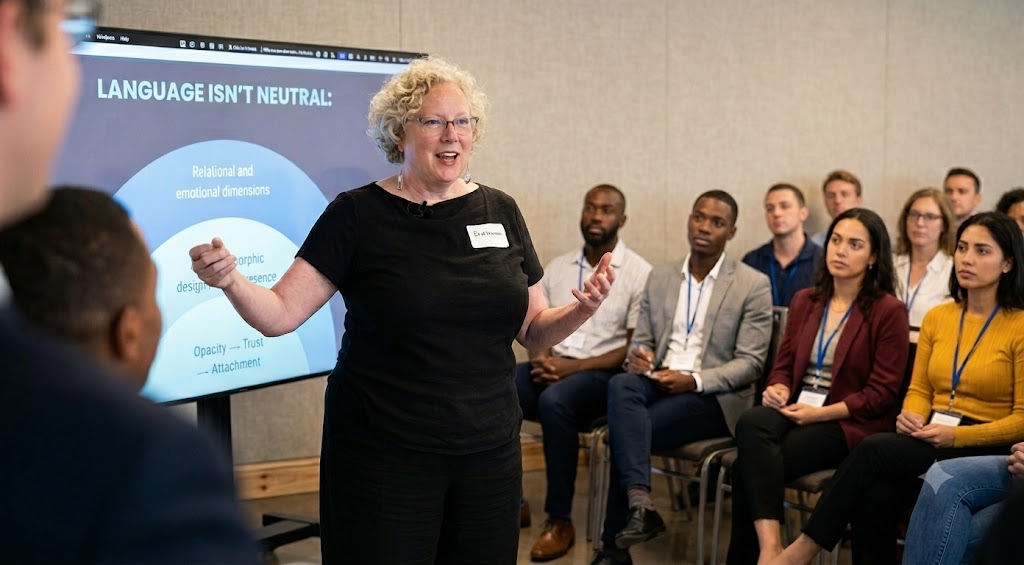
Erika Lenz teaching a workshop, gesturing beside a slide on how language isn't neutral, with participants seated around her

Your company bought the tools. The thinking skills weren't included.

That gap is yours to close — and it's more closeable than the market wants you to believe. Start free: one letter a week on keeping your mind in the age of AI. Then decide.

No hacks, no hype, unsubscribe anytime.